Rooted in Stillness: What Europe's Ancient Kitchen Gardens Teach Americans About Healing Through the Soil
There is a particular kind of silence that settles over a well-tended garden in the early morning — a silence that is not empty, but full. It is the silence of dew on broad bean leaves, of earthworms turning through dark soil, of a season progressing at precisely the pace it has always kept. In the villages of Normandy, the hillside plots of Tuscany, and the orderly cottage gardens of Bavaria, this silence has been cultivated alongside the vegetables for generations. It is, in its own quiet way, a form of wisdom.
For Americans navigating the relentless acceleration of contemporary life — the notifications, the deadlines, the ambient pressure to optimize every hour — this European tradition of the kitchen garden presents something quietly radical: a practice that cannot be rushed.
The Potager and the Bauerngarten: Gardens with a Philosophy
The French potager is perhaps the most celebrated expression of the European kitchen garden tradition. More than a vegetable patch, it is a composition — herbs arranged beside climbing roses, lettuces bordered by marigolds, espaliered fruit trees trained against sun-warmed stone walls. The design principles of the great potager at the Château de Villandry in the Loire Valley, with its geometric beds and layered plantings, reflect a centuries-old conviction that beauty and utility need not be separated. A garden that feeds the body, the French understood, ought also to nourish the eye and calm the spirit.
In Germany and Austria, the Bauerngarten — literally the farmer's garden — carries a similarly integrated philosophy. These cottage gardens, overflowing with medicinal herbs, edible flowers, and seasonal vegetables, were historically tended by women who understood the garden as both larder and apothecary. The knowledge passed through generations was not merely botanical; it was a kind of attentiveness, a practice of observing closely and responding thoughtfully to what the earth offered.
The Dutch moestuin, the Spanish huerto, the Italian orto — each carries its own regional character, yet all share a foundational premise: that the relationship between a person and a small plot of cultivated ground is inherently restorative.
Why the Soil Is the Antidote
Contemporary research has begun to validate what European gardeners have long understood intuitively. Studies from the United Kingdom and the Netherlands suggest that regular contact with garden soil — specifically with the bacterium Mycobacterium vaccae found in healthy earth — may stimulate serotonin production and reduce anxiety. Gardening interventions have been incorporated into mental health treatment programs across Scandinavia and the United Kingdom, where the practice is referred to, with characteristic northern pragmatism, as ecotherapy or green care.
Yet the science, however compelling, somewhat misses the point. The European kitchen gardener is not tending the soil in pursuit of a neurochemical outcome. She is doing so because the garden operates on a timescale that resists urgency. Seeds germinate when they are ready. Frost arrives on its own schedule. The tomato ripens without consulting a calendar. To participate in this process — genuinely, with one's hands in the ground — is to accept, at least for an hour, that not everything can be accelerated.
This acceptance is, in itself, a form of mindfulness. It is perhaps the most tangible form available to those who find seated meditation elusive.
The American Burnout and the Missing Ritual
Burnout in the United States has become something of a cultural condition rather than a personal failing. The American Psychological Association's annual stress surveys consistently reveal that a significant portion of the adult population reports feeling overwhelmed, fatigued, and disconnected — symptoms that digital wellness solutions, however well-intentioned, have proven inadequate to address. The problem, many wellness researchers now suggest, is not a lack of relaxation techniques but a severing from what the philosopher Albert Borgmann called focal practices: activities that are inherently engaging, require genuine skill, and connect us to something larger than our immediate concerns.
The kitchen garden is precisely such a practice. It demands presence without demanding performance. One cannot half-heartedly water a seedling while scrolling through email; the attention required, though gentle, is real. And unlike so many contemporary wellness interventions, the kitchen garden produces something tangible — a handful of radishes, a jar of dried lavender, a bowl of tomatoes that taste, unmistakably, of summer and effort.
Beginning Your Own Practice: Scale and Simplicity
One of the most liberating aspects of the European kitchen garden tradition is its indifference to scale. The potager at Villandry may occupy several acres, but the tradition it represents was born in much smaller spaces — in monastery courtyards, on urban windowsills, in the narrow strips of ground behind terraced houses in Lyon or Ghent.
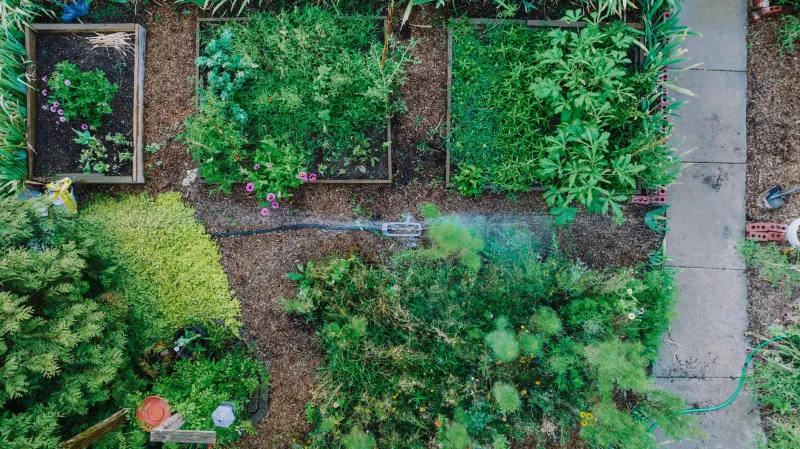
For Americans living in apartments or homes with minimal outdoor space, the principles translate readily. A collection of terracotta pots on a south-facing balcony can accommodate herbs, cherry tomatoes, and lettuces. A single raised bed — even four feet by eight feet — is sufficient to practice the seasonal rhythms that make kitchen gardening meditative rather than merely productive.
The key, as European gardeners have always known, is to resist the temptation to do too much at once. Begin with what is simple and forgiving: radishes, which germinate in days and reward impatience with results; basil, which demands warmth and regular attention and returns the favor with extraordinary generosity; a single climbing bean, which will teach you, in the course of one season, more about patience than most wellness retreats.
Choose varieties with intention. Seek out heirloom seeds from European traditions — the Marmande tomato from southwestern France, the Painted Lady runner bean that has been grown in English cottage gardens since the seventeenth century, the Genovese basil whose fragrance transforms a small urban balcony into something approaching the Mediterranean. These are not merely plants; they are threads connecting your small plot to a very long history of human beings finding solace in the act of cultivation.
The Rhythm That Remains
What the European kitchen garden ultimately offers is not a productivity hack dressed in pastoral clothing. It offers something older and more necessary: a rhythm. The rhythm of planting and waiting, of tending and harvesting, of the soil resting through winter before it stirs again in spring. This rhythm exists entirely outside the attention economy. It cannot be optimized, monetized, or condensed into a five-minute morning routine.
In a culture that has grown profoundly uncomfortable with slowness, this may be the kitchen garden's most subversive quality. To kneel beside a raised bed and press seeds into warm soil is to enter, however briefly, into a different relationship with time — one that Europeans have been quietly cultivating for centuries, and one that may be precisely what the American spirit most urgently needs.
The garden does not ask for much. It asks only that you show up, pay attention, and allow things to grow at their own pace. In that simplicity lies something that resembles, very closely, peace.