Wandering Without Destination: How the French Practice of Flânerie Offers Americans a New Kind of Freedom
There is a particular kind of guilt that settles over Americans who find themselves without a task. To sit without reading, to walk without a destination, to exist without producing—these feel, in the American cultural imagination, less like rest and more like failure. Productivity is not merely a habit in the United States; it is a moral framework. And yet, across the Atlantic, a centuries-old French tradition quietly insists that some of the most meaningful human experiences arise precisely when purpose is abandoned.
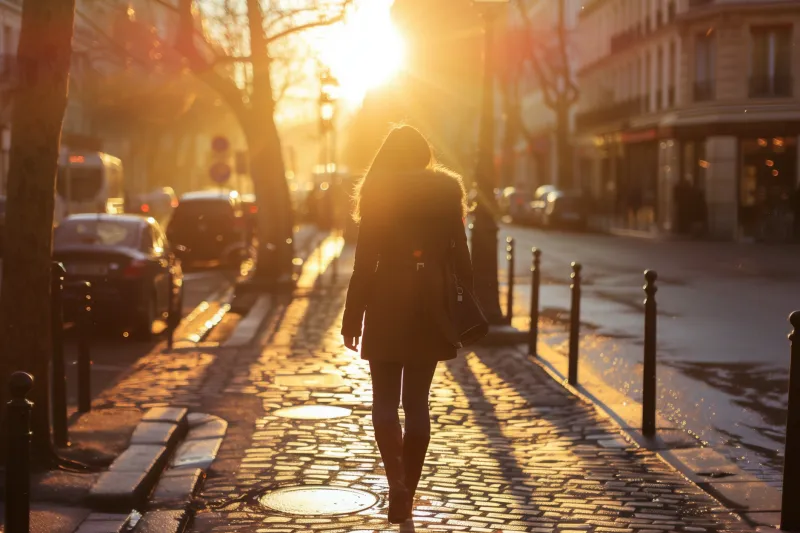
That tradition is flânerie: the practice of wandering through urban and natural landscapes with deliberate aimlessness, attending to the world not as a resource to be extracted but as a spectacle to be absorbed. The flâneur—a term popularized by the poet Charles Baudelaire and later examined by the philosopher Walter Benjamin—is not lazy. He is, in fact, intensely engaged. He notices the light shifting across a limestone facade, the particular cadence of a street musician's rhythm, the way a stranger's expression tells an entire unspoken story. He is, above all, present.
For Americans navigating a wellness landscape increasingly crowded with apps, metrics, and optimized routines, flânerie offers something genuinely different: a practice that cannot be quantified, scheduled, or perfected.
The Philosophical Roots of Purposeless Walking
To understand flânerie, one must appreciate that it was never merely a leisure activity. When Baudelaire described the flâneur as a "passionate spectator" who finds his home in "the ebb and flow, the bustle, the fleeting and the infinite" of city life, he was articulating a philosophical stance toward existence itself. The flâneur does not move through the world in order to arrive somewhere. He moves in order to see.
This distinction matters enormously. Goal-oriented walking—whether a morning run tracked by a fitness device or a tourist's march between landmarks—keeps the mind anchored in the future. Flânerie, by contrast, demands a radical orientation toward the present moment. It is, in this sense, a form of mindfulness that predates the contemporary wellness industry by well over a century.
Benjamin, writing in the early twentieth century, recognized the flâneur as a figure who resisted the mechanizing pressures of modern urban life. That resistance feels, if anything, more urgent now than it did then.
What Neuroscience and Urban Design Are Beginning to Confirm
Contemporary researchers are arriving, through entirely different methods, at conclusions that Baudelaire might have recognized. Studies in environmental psychology have demonstrated that unstructured time spent in urban environments—particularly when walking at a relaxed pace—activates what neuroscientists call the default mode network, a constellation of brain regions associated with creativity, self-reflection, and the integration of complex emotional experience.
Urban planners have also begun to take seriously the design conditions that make genuine wandering possible. Cities that prioritize pedestrian scale, architectural variety, and what designers call "permeability"—the sense that streets invite exploration rather than efficient transit—tend to produce measurably higher reported wellbeing among their residents. Paris, with its arrondissements of varied character, its covered passages, its unexpected courtyards, was, perhaps not coincidentally, designed to reward the aimless walker.
Many American cities, built around the automobile and organized by commercial function, present a more hostile environment for the aspiring flâneur. But this does not render the practice impossible—it simply asks that Americans look more carefully at what their own communities contain.
Practicing Flânerie in an American Context
The first and most essential step toward flânerie is the deliberate abandonment of the itinerary. This sounds simple. It is, for most Americans, surprisingly difficult. The instinct to plan—to identify a coffee shop, a park, a point of interest—must be consciously resisted. The flâneur departs without a map and follows curiosity wherever it leads.
This might mean turning down a residential street that has always been passed without attention, pausing before a building whose architectural details have never been examined, or simply sitting on a bench and watching the particular choreography of a city block for longer than seems socially comfortable. The discomfort itself is instructive. It reveals how thoroughly the imperative to do has colonized even our leisure hours.
Several practical orientations can support the practice:
Slow the pace considerably. Flânerie is incompatible with exercise-walking speed. The body should move at a pace that allows the eyes to genuinely register what they encounter. This alone will feel transgressive to many Americans.
Leave the headphones behind. The sonic environment of a city—its ambient conversations, its mechanical rhythms, its unexpected silences—is as much a part of the experience as its visual character. Auditory presence is non-negotiable.
Resist the urge to document. The phone, with its camera and its social platforms, converts experience into content. The flâneur's observations belong to himself alone. They are processed internally, allowed to settle, permitted to become part of one's inner life rather than one's public presentation.
Follow what draws you, not what makes sense. If a particular alley looks interesting for no articulable reason, enter it. If a park bench offers an unexpectedly pleasant view, occupy it without feeling the need to justify the pause.
The Deeper Gift: Reclaiming a Relationship with Meaning
What flânerie ultimately offers is not merely relaxation—though it does provide that. It offers a reorientation of the question "What am I doing with my time?" toward the more searching inquiry: "What am I noticing about being alive?"
In the American cultural framework, meaning is almost always understood as the product of achievement: the completed project, the reached destination, the accomplished goal. Flânerie proposes a different economy of meaning, one in which significance accumulates through attention rather than accomplishment. The afternoon spent wandering without purpose is not an afternoon wasted; it is an afternoon in which the world was genuinely encountered.
This distinction has profound implications for how Americans understand rest, creativity, and even professional effectiveness. Many of the most generative insights reported by writers, architects, and designers arise not during focused work sessions but during precisely the kind of receptive, unhurried observation that flânerie cultivates. The mind, released from the obligation to produce, often produces its most original work.
An Invitation to Stillness in Motion
Stilhed—stillness—does not always require the absence of movement. The French flâneur understood that one could be in motion and simultaneously at rest, walking through the world without being driven by it. This is, perhaps, the most counterintuitive and most necessary lesson that European contemplative traditions hold for American readers.
To wander without destination is not to opt out of life. It is to step more fully into it—to allow the texture of the present moment to register without immediately asking what it is for. In a culture that has made busyness into a virtue, this may be the most quietly subversive act available.
The streets are there. The light is changing. There is nowhere, for once, that you need to be.