The Unhurried Hour: What European Café Culture Can Teach Americans About the Lost Art of Leisure
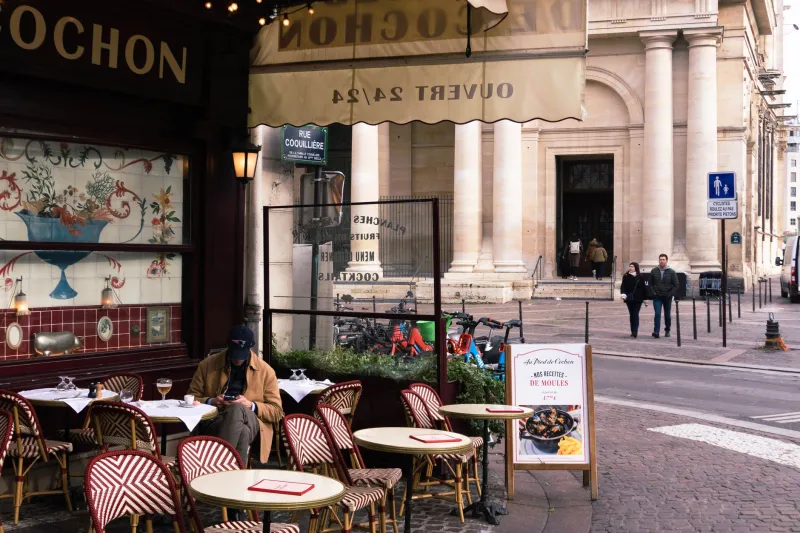
There is a particular kind of afternoon light that falls through the windows of a Viennese coffeehouse — amber, unhurried, entirely indifferent to the hour. A man at a corner table has been nursing a Melange for the better part of two hours. He is not working. He is not scrolling. He is, in the truest sense of the phrase, simply there. To an American visitor, this scene may register as unusual, even vaguely suspicious. To the Viennese, it is simply Tuesday.
This distinction — small in appearance, vast in implication — sits at the heart of one of the most meaningful cultural divergences between European and American life. The café, in its continental form, is not a fuel stop or a co-working space dressed in exposed brick. It is a room designed for the practice of presence. And in a country where busyness has long functioned as a status symbol, the European café tradition presents something genuinely countercultural: the philosophical permission to do nothing at all.
A Continent Built for Lingering
The café as a social and cultural institution has deep roots across Europe, though its character shifts meaningfully from city to city. In Vienna, the Kaffeehaus tradition dates to the seventeenth century and was formally recognized by UNESCO as an element of intangible cultural heritage. These establishments were — and remain — places where writers composed, philosophers argued, and ordinary citizens passed entire afternoons in reflective solitude or unhurried conversation. The expectation was never that one would leave quickly.
In Paris, the café de quartier operates on similar principles, though with a distinctly French emphasis on the pleasures of observation. The outward-facing terrace, chairs angled toward the street, is a deliberate architectural invitation to watch the world without participating in it at pace. French sociologists have long noted that the café functions as a kind of democratic living room — a public space in which the act of lingering carries no social stigma and requires no justification.
Move south to Italy, and the ritual contracts in duration but deepens in intensity. The Italian bar is a place of standing espresso consumed in under three minutes, yet even here the pause is sacred. The coffee break is not stolen time; it is protected time, a moment of sensory focus that punctuates the working day with intention rather than apology.
Each of these traditions, different as they are, shares a common philosophical foundation: that leisure is not the absence of productivity but a distinct and worthy mode of human experience.
The American Relationship With Idle Time
The contrast with American café culture is instructive. The rise of the third-wave coffee movement in the United States brought genuine reverence for craft and origin, yet the physical environments it produced often tell a different story. Laptop-open patrons, standing desks, ambient music calibrated to sustain focus — the American café frequently functions as an extension of the office rather than an antidote to it. Even the language of ordering — a transaction optimized for speed — reflects a cultural discomfort with occupying space without a clear purpose.
Psychologists who study leisure and well-being have identified what some call leisure guilt — the persistent, low-grade anxiety that arises when one is not engaged in something measurably productive. Research published in the Journal of Experimental Social Psychology suggests that Americans experience this phenomenon at notably higher rates than many of their European counterparts, and that it measurably diminishes the restorative benefits of rest. In other words, the inability to fully inhabit a moment of stillness renders that moment less restorative — a kind of compounding loss.
The European café tradition, in its various forms, functions as a cultural antidote to precisely this condition. It does not merely permit idleness; it architecturally and socially enshrines it.
The Psychology of the Long Sit
What happens, neurologically and psychologically, when a person genuinely allows themselves to linger without agenda? Researchers in the field of attention restoration theory suggest that environments which invite soft, undirected attention — a café window, a slow cup of coffee, the ambient murmur of a room — allow the prefrontal cortex to recover from the directed-attention fatigue that accumulates through sustained, goal-oriented work. The European café, with its unhurried pace and sensory richness, is, in this reading, a naturally restorative environment.
Beyond neuroscience, there is something to be said for the social dimension of visible leisure. In cultures where lingering is normalized, the act of sitting quietly in a public space carries no implicit judgment. One is not perceived as unambitious or unoccupied in any pejorative sense. This social permission — invisible but enormously powerful — makes genuine rest far more accessible.
Bringing the Café Mindset Home
For American readers drawn to this tradition, the good news is that its essential qualities are not confined to Europe. They are, at their core, a matter of intention and permission — both of which are portable.
Choose your space with care. Not every coffee shop is equally conducive to unhurried presence. Seek out establishments that do not impose time limits on seating, that prioritize atmosphere over throughput, and that offer something worth looking at — a window onto a busy street, artwork on the walls, the comfortable geometry of a well-designed room. Independently owned neighborhood cafés are frequently better suited to this purpose than chain locations.
Leave the laptop behind. This is perhaps the most significant behavioral shift. The moment a screen opens, the café ceases to function as a restorative space and becomes, once again, a workspace. Bring a book, a notebook, or nothing at all. Allow your attention to move as it wishes.
Order with deliberateness, not efficiency. Choose something you genuinely wish to taste rather than something that will deliver caffeine most rapidly. Sit with it. Notice it. The Italian practice of attending fully to a short espresso is as valid as the Viennese practice of extending a single coffee across an afternoon — what matters is that the experience is inhabited rather than consumed.
Release the productivity calculus. This is the most difficult step for many Americans, and it is also the most important. Time spent in genuine leisure is not wasted time. It is, in a very real sense, an investment in the quality of the attention and energy you bring to everything else. Granting yourself permission to simply be present — without output, without optimization — is not indulgence. It is, as the Europeans have long understood, a form of wisdom.
Stillness as a Practice, Not a Destination
The European café does not promise transformation. It offers something quieter and, arguably, more valuable: a reliable container for the experience of unhurried time. In a culture that has come to treat every waking hour as a resource to be allocated, this is a genuinely radical proposition.
To sit, to sip, to watch the light change on a Tuesday afternoon — this is not nothing. This, the continental tradition gently insists, is among the most human things one can do. The stillness it cultivates is not passive. It is, for those willing to practice it, a quiet and sustaining form of freedom.